
Microsoft and Unix redux

In an otherwise insightful critique of Malcolm Gladwell’s assertion that Steve Jobs was a tweaker rather than a visionary, John Gruber says this about Bill Gates:

Gates was (and remains) a large-scale visionary in his own right. He was simply never a product visionary. But the whole idea that software in general could be more valuable than hardware — or even just valuable, period? Gates. The man pioneered the concept of selling software. The idea that a software platform could be created that ran everywhere, on almost all hardware? Gates.

I agree with the software v. hardware thing, but did Gates really pioneer the notion of a software platform that could run on almost all hardware? No.

As I said in that post in September, Unix was there well before Microsoft.

Microsoft has always wanted to be seen as an innovator in developing operating systems that ran on computers from different vendors. Unix is an inconvenient truth that interferes with that image.

In fact, neither DOS nor Windows ever “ran everywhere, on almost all hardware.” Microsoft pretty much stuck with Intel hardware and Intel workalikes. I recall Windows NT running (poorly, I think, and not for long) on PowerPCs, the DEC Alpha, and some other RISC chips (Wikipedia says the MIPS R4000) but non-Intel processors were strictly a sideline.

Unix, on the other hand, really did run on a wide range of hardware. The well-known NUXI problem originated when Unix was ported from its initial PDP hardware to a system with different endianness. My prized copy of the special Unix issue of the Bell System Technical Journal has two papers about porting Unix to non-PDP systems, and that was in 1978, two years before Microsoft bought QDOS and turned it into PC-DOS for IBM.
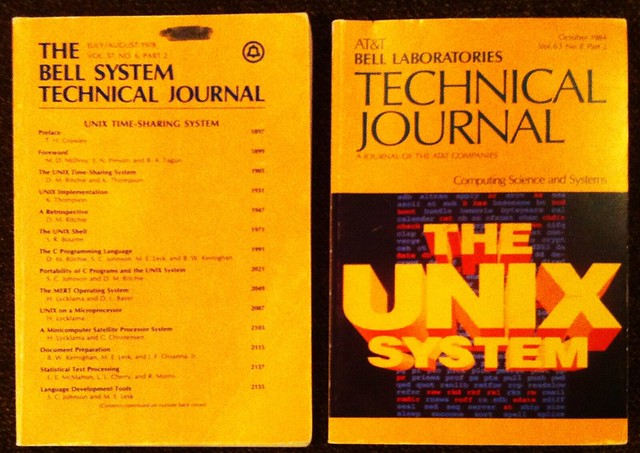
Unix issues of the Bell System Technical Journal

No question, Gates was a visionary in recognizing the primacy of software over hardware, and—most importantly—he acted on that vision. But when it comes to operating system portability, he was a follower. Unix did it first and did it better.


7 Responses to “Microsoft and Unix redux”

  1. koook says:

    How many people ran UNIX systems in there home vs DOS(/Windows)?

  2. Dr. Drang says:

    If ubiquity is the standard, then Microsoft pioneered everything in the software world.

  3. Clark says:

    There was also CPM which ran on a slew of computers. Including the famous Osborne 1, the first portable computer and Radio Shack’s TRS-80 line of computers.

    Unix ran on a few computers but honestly not that many all things computer. I remember learning C on an old Vax running Unix instead of VMS. It was fun. I seem to remember a few other OSes that predated DOS as well. However it’s clear that DOS was highly influenced by both Unix and CPM - probably more CPM than Unix.

  4. Clark says:

    I should add that Gate’s major innovations were all in terms of business process and marketing for software. I don’t think one should neglect his brilliance in that, although some of what he did was borrowing from IBM in the prior decades. However much of what Microsoft the company did was copy rather blatantly without extra “tweaking” what was going on before and then use various strategies to dominate the field. Honestly though even there I think their competitors often screwed themselves up more than Microsoft succeeded on their own. Say what one will about Lotus, Word Perfect and even Apple, but it was more those companies failures than Microsoft’s competence that led to more than a decade of Microsoft dominance. (I think the same thing is happening now with Apple versus everyone else except I don’t think Apple wants to dominate so Windows and Android end up having more marketshare)

  5. Dr. Drang says:

    You’re right, Clark, I should have mentioned CP/M as another “universal” OS that preceded DOS.

    I attended a short course in DOS back in the mid-80s in which the instructor gave a history of DOS to that point. As I recall, the earliest DOS versions were mostly CP/M, with Unix influences moving in as it matured.

  6. James says:

    CP/M was a nicer system but it’s creator/founder was not a “business guy” and could never have hoped to compete with the likes of Gates. Gary Kildall was a lot like Wozniak, brilliant technologist but completely naive when it came to business. DOS was a rip off of CP/M and UNIX whose author thought it would go nowhere. He wrote it for his own companies use and had no idea of it’s value. DOS only became valuable in Gates hands when they cut a deal with IBM without actually having an OS. So they bought DOS for $50k and licensed it to IBM as well as the clones.

    The entire Silicon Valley explosion was based on the PC revolution and was a direct result of Motorola and Intel making CPU’s that were cheap enough to build smaller personal computers and having so many engineers in the same location who liked to tinker.

    UNIX was never a part of the PC revolution beginnings. It wasn’t until FreeBSD / Linux hit the scene, traditional UNIX systems only ran on expensive high end workstations. But it was completely portable from platform to platform because it’s written entirely in C and is designed in a simpler and more modular fashion where pieces of it do one thing well and work together to do powerful things. Linux was born out of a poor students frustration with a closed Unix like training OS and the high cost of commercial Unix systems. But the Internet is completely built on Unix and were it not for Unix there would be no Internet. Unix dominated Universities and thus the Internet was born on Unix. When the Internet was realized by businesses, Unix penetrated their data centers. Linux matured and has replaced many of the proprietary Unix systems but likely won’t replace all of them. Solaris still has many tricks up it’s sleeve that Linux cannot perform. Although FreeBSD beat Linux by years, it never dominated like Linux did. Not entirely sure why. Suspect politics…

  7. middleware says:

    Not to mention Mac OS X made the transition from PowerPC to Intel within six months.